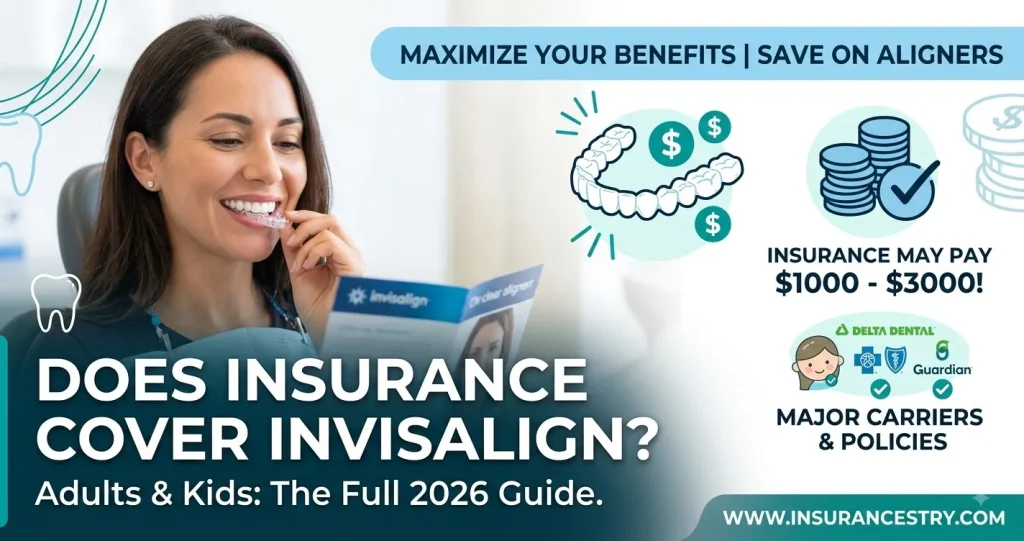
Yes, many dental insurance plans do cover Invisalign. Typically they will cover between $1,000 to $3,000 or about 25% to 50% of the overall treatment costs. However coverage is heavily dependent on whether your specific policy has an orthodontic rider as regular preventative and restorative dental coverage does not cover clear aligners.
Dental coverage can be confusing, especially when you’re attempting to get a clear picture of your exact out of pocket balance. Here’s a real life description of how orthodontic coverage works, why age limits matter, how major U.S. carriers treat clear aligner claims, and how to optimize your policy benefits.
How Does Dental Insurance Cover Invisalign?
You’ll need to know the difference between general dental insurance and orthodontic insurance to find out whether your policy covers clear aligners.
Dental policies usually include coverage for preventive treatments (cleanings, X-rays), basic operations (fillings, small extractions) and significant services (crowns, root canals). Invisalign is considered exclusively an orthodontic benefit. If you do not have an orthodontic rider on your policy your insurance company will not pay for treatment no matter how crowded or crooked your teeth are.
If your policy does cover orthodontics, then insurance companies often regard Invisalign the same as traditional metal braces. Aligner coverage is paid from a Lifetime Orthodontic Maximum, not a year-to-year reset like traditional benefits
What Is a Lifetime Orthodontic Maximum?
A lifetime orthodontic cap is a one-time benefit, per member, not your yearly maximum benefit (which resets every year on January 1st). Once you’ve used it up it is gone forever (even if your treatment spills over into the next calendar year).
- Percentage Split: Many insurance will pay a percentage (often 25% to 50%) up to that predetermined lifetime maximum.
- So if your total cost of Invisalign treatment is $5,500 and your policy pays 50% up to a $2,000 lifetime limit, your insurance pays $2,000. You pay the other 3500 dollars.
Does Dental Insurance Cover Invisalign for Adults?
One of the most frequent roadblocks patients encounter is age restriction. If you’ve wondered, “Does insurance cover Invisalign for adults?” the answer requires checking your policy’s fine print.
Family insurance frequently provide orthodontic treatment for children under 19, but adult orthodontic coverage is not as readily available. Many conventional employer-sponsored plans have tight age restrictions that cut off enrollment at age 18 or 19. Once a member turns 19, the orthodontic benefit is $0.
But more firms are beginning to include comprehensive wellness choices in their benefits packages. If you have a premium dental PPO, chances are good that adult orthodontia is covered. When you review a policy, ask your HR department or insurer directly, “Is there an age limit on my plan’s orthodontic coverage?”
Major Provider Breakdown: Does Any Insurance Cover Invisalign?
When you’re searching for coverage or looking at alternatives during open enrollment, here’s a look at how top U.S. dental insurers often treat clear aligners:
| Insurance Provider | Typical Coverage Structure | Key Policy Details |
| Blue Cross Blue Shield | Partial coverage available under select PPO plans | Does Blue Cross insurance cover Invisalign? Yes, if an orthodontic rider is attached. Age caps often apply on individual plans. |
| Delta Dental | Partial coverage (often 25%–50% up to lifetime cap) | Requires PPO or Premier plans with orthodontic riders; pre-authorization is strongly recommended. |
| Cigna | Partial coverage on select group plans | Lifetime orthodontic caps typically range between $1,000 and $1,500. |
| Guardian Insurance | Partial coverage on select tier plans | Does Guardian insurance cover Invisalign? Yes, on higher-tier plans, though waiting periods (6–12 months) often apply. |
| MetLife | Partial coverage available | Requires formal pre-determination claims before starting aligner fabrication. |
| Humana | Partial coverage or negotiated network discounts | Some individual plans provide flat-rate fee discounts for network orthodontists rather than direct benefit payouts. |
Key Exclusions and Fine Print to Check First
Check your Summary of Benefits for these important conditions before you begin treatment:
- Waiting Periods: For individual and family plans acquired from the open market there may be a waiting period of 6 to 12 months before orthodontic benefits are available.
- Network Requirements: When you see a provider in your network, you will receive negotiated discount rates which decreases your overall cost before insurance pays their share.
- Medical Necessity vs. Cosmetic Classification: Minor spacing problems are cosmetic but serious biting problems (overbites, underbites, crossbites or jaw pain) might be documented by your doctor as medically necessary, decreasing the chance of a claim denial.
Smart Ways to Pay for Invisalign Beyond Insurance
If your policy doesn’t cover clear aligners, or if you reach your lifetime maximum soon, you can reduce your out-of-pocket costs with a number of options:
Flexible Spending Accounts (FSA) & Health Savings Accounts (HSA)
FSA or HSA pre-tax dollars can cover Invisalign. Depending on your federal tax level, paying using pre-tax dollars can be an effective way to save 20% to 30% on overall costs.
Office Payment Plans In-House
Most dental and orthodontic practices will have little or no interest monthly payment plans. The debt can be spread over 12 to 24 months, often bringing the payments down to $99 to $200 a month.”
Health Care Financing Programs
Third-party healthcare financing solutions enable you to finance your treatment over a longer period of time, often with promotional zero delayed interest periods.
How to Use the Coverage Verification Checklist
Here’s what you need to do before your consultation to work out exactly what you’ll pay out of pocket:
- Call the member services number on the back of your dental insurance card.
- Ask specific questions to validate
- Will my policy cover the orthodontic CDT codes D8080 and D8090?
- Does my plan cover clear aligners like Invisalign at the same level as traditional braces?
- Is there an age limit on orthodontic benefits?What does my Lifetime Orthodontic Maximum cover?
- Will I have to wait for my orthodontic coverage to take effect?
- Pre-Treatment Estimate: Have your dentist or orthodontist file a formal pre-authorization claim with your insurer. Before you sign a financial contract you will receive an official Explanation of Benefits (EOB) that will tell you the exact cash amount your insurer will pay.
Frequently Asked Questions About Invisalign Insurance Coverage
Invisalign expenses are usually between $3,000 and $8,000. But most insurers will only cover a certain amount for your lifetime, between $1,000 and $3,000. Most patients will pay out-of-pocket between $2,000 and $5,000, which can be divided into monthly payment plans or paid with HSA/FSA dollars.
Yes. If your coverage contains a rider for orthodontic benefits, insurers nearly typically cover transparent aligners under the same percentage and lifetime maximum guidelines as traditional metal braces.
Some of the most common reasons are:
Your plan does not have an orthodontic rider.
You reach an adult age cap (typically age 19).
You are in a waiting period (6-12 months)
You have already used your Lifetime Orthodontic Maximum on previous treatment.
Orthodontic claims are based on the difficulty of the treatment and the age of the patient therefore the brand of the orthodontic is not important:
D8080: Orthodontic therapy, complete, adolescent
D8090: Comprehensive orthodontic treatment, adult.
D8020 / D8030: Limited orthodontic therapy for correction of minor tooth alignment.
Yes, you can coordinate the benefits if you carry two dental policies (for example, one provided by your employer and one provided by your spouse’s employment). The primary plan pays first and the secondary plan may pay the remaining payment up to the secondary plan’s lifetime orthodontic maximum.