If you are trying to figure out whether you are legally required to have health insurance in the United States, you are not alone. The rules have changed significantly over the last several years.
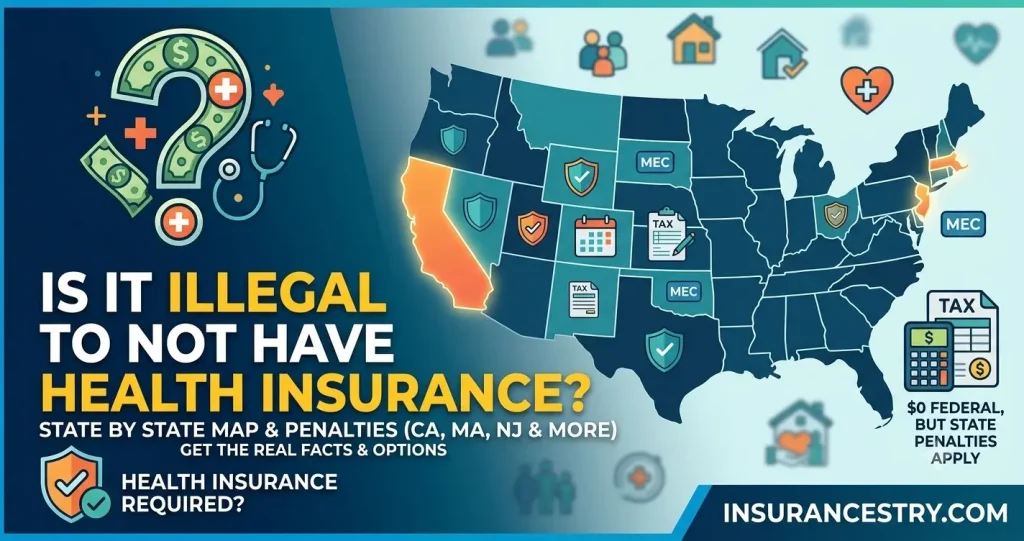
To answer the most common question directly: No, it is not illegal to go without health insurance at the federal level, and there is no longer a federal tax penalty for being uninsured. However, health insurance is legally required in several states, including California, Massachusetts, and New Jersey. In those states, you will face a penalty on your state tax return if you do not carry qualifying coverage.
Even where it is perfectly legal to go uninsured, doing so carries massive financial risks. A single unexpected illness or injury can result in tens of thousands of dollars in out-of-pocket medical debt.
This comprehensive guide will break down the exact laws across the country, outline state-specific penalties, explore what health insurance costs, and help you find affordable coverage options to protect both your health and your finances.
The History of the Individual Mandate: What Changed?
To understand the current legal landscape, we have to look back at the Affordable Care Act (ACA), also known as Obamacare.
When the ACA was signed into law, it established what was known as the individual mandate. Under this federal law, most Americans were legally required to maintain qualifying health insurance—officially termed Minimum Essential Coverage (MEC)—or pay a financial penalty on their federal income tax returns.
At its peak, the federal penalty was quite high: either $695 per adult (plus $347.50 per child) or 2.5% of your household income above the tax-filing threshold, whichever was greater.
This federal penalty officially ended when the Tax Cuts and Jobs Act took effect. This law reduced the federal penalty to $0. While the technical structure of the individual mandate remains on the books, it has no financial teeth at the federal level. The Internal Revenue Service (IRS) will not penalize you or block your federal tax refund for being uninsured.
However, several forward-thinking states realized that without a mandate, healthy people might drop out of the insurance pool, driving up premiums for everyone else. To keep their insurance markets stable, these states passed their own state-level individual mandates.
State-by-State Health Insurance Requirements
If you reside in a state with an active individual mandate, you must prove you had qualifying health insurance during the tax year. If you did not, you will owe a penalty when you file your state tax return, unless you qualify for a state-approved exemption.
The requirements and penalties vary significantly across these jurisdictions.
| State / Territory | Legal Mandate? | Current Penalty Structure | How It Is Managed |
| California | Yes | At least $900 per adult and $450 per child, or 2.5% of household income (whichever is greater). | California Franchise Tax Board (FTB) |
| Massachusetts | Yes | Based on a sliding scale up to $1,620 per year per adult. No penalties for those below 150% of the Federal Poverty Level (FPL). | Massachusetts Dept. of Revenue |
| New Jersey | Yes | Starts at $750 per adult and $375 per child, up to a maximum household cap. | New Jersey Division of Taxation |
| Rhode Island | Yes | Minimum of $750 per adult or 2.5% of household income. | Rhode Island Division of Taxation |
| Washington, D.C. | Yes | Minimum of $750 per adult or 2.5% of household income. | D.C. Office of Tax and Revenue |
| Vermont | Yes | $0. Reporting is required on state tax forms, but there is no financial penalty. | Vermont Department of Taxes |
| All Other States | No | $0. No state-level mandates or tax filing penalties. | N/A |
Is It Illegal to Not Have Health Insurance in California?
Yes, California enforces its mandate strictly. If you live in California and go without qualifying health coverage, you must pay the penalty when filing your state income taxes. For a family of four, the baseline penalty can easily exceed $2,700 per year, making it far smarter to use those funds toward a subsidized health plan through Covered California.
Is It Illegal to Not Have Health Insurance in Massachusetts?
Yes, Massachusetts was the pioneer of healthcare reform, establishing its mandate in 2006. The state’s penalty is calculated on a sliding scale based on your income and the cost of the cheapest health plan available to you. If you are deemed able to afford coverage but choose to remain uninsured, you will be penalized on your state return.
Is It Illegal to Not Have Health Insurance in New Jersey?
Yes, New Jersey adopted its individual mandate shortly after the federal penalty dropped to zero. The state’s penalty closely mirrors the old federal formula. If you do not have Minimum Essential Coverage, you will face the New Jersey Health Insurance Mandate penalty (NJ-HCC).
What Counts as “Minimum Essential Coverage” (MEC)?
To satisfy both state mandates and avoid paying steep penalties, your health plan must meet the standards of Minimum Essential Coverage. Fortunately, most standard health plans in the United States qualify.
Types of Plans That Meet the Mandate:
- Employer-sponsored coverage: Plans provided by your job (or your spouse’s job), including COBRA coverage.
- Marketplace plans: Health plans purchased through Healthcare.gov or state-based exchanges (like Covered California or Get Covered NJ).
- Government programs: Medicare (Part A or C), Medicaid, and the Children’s Health Insurance Program (CHIP).
- TRICARE and VA healthcare: Coverage provided by the federal government for military members, veterans, and their families.
- Student health plans: Qualifying health insurance plans offered by universities and colleges.
Plans That Do NOT Meet the Mandate:
Some alternative health products are useful for filling temporary gaps, but they generally do not count as Minimum Essential Coverage:
- Short-term, limited-duration health insurance.
- Fixed indemnity policies (which pay a set cash amount per day in the hospital).
- Dental-only or vision-only plans.
- Accident or critical illness insurance.
- Health Sharing Ministries (unless specifically exempted by your state’s tax laws).
How Health Insurance Costs and Financial Dynamics Work
Understanding the components of your health insurance policy is critical to selecting the right coverage and budgeting effectively.
1. Premiums
A premium is the recurring monthly amount you pay to your insurance company to keep your policy active. Think of it like a subscription fee. You must pay this whether you go to the doctor or not.
2. Deductibles
The deductible is the amount of money you must pay out-of-pocket for medical services before your insurance company begins paying its share. For example, if you have a $3,000 deductible, you must pay the first $3,000 of your medical bills.
3. Copayments and Coinsurance
Once you meet your deductible, you share the remaining costs with your insurer through:
- Copayments (Copays): A flat fee you pay for a specific service (e.g., a $25 copay for a primary care doctor visit).
- Coinsurance: A percentage of the cost of a medical service (e.g., you pay 20% of an MRI cost, and the insurer pays 80%).
4. Out-of-Pocket Maximum
This is the absolute most you will have to pay for covered medical services in a single plan year. Once your deductibles, copays, and coinsurance add up to this limit, your insurance plan pays 100% of your covered healthcare costs for the rest of that year.
Pros and Cons of Going Without Health Insurance
To help you make an informed decision, let’s weigh the direct advantages and disadvantages of choosing to go uninsured.
The Drawbacks (Cons) of Being Uninsured:
- Extreme Financial Vulnerability: The cost of medical care in the U.S. is incredibly high. An overnight hospital stay can cost over $10,000, and treating a broken leg can easily run $15,000. Without insurance, you are solely responsible for these bills.
- No Access to Preventive Care: Under the ACA, health plans must cover annual checkups, immunizations, and cancer screenings with $0 out-of-pocket costs. If you are uninsured, you must pay out-of-pocket for these preventive visits.
- State Penalties: As detailed above, you could face tax penalties up to thousands of dollars depending on your state of residence.
- Strict Enrollment Windows: You cannot simply wait until you get sick to buy health insurance. You can only sign up during the annual Open Enrollment Period (typically November 1 through January 15) unless you experience a qualifying life event.
The Only “Pro” of Being Uninsured:
- Short-Term Monthly Savings: You will save money on monthly premiums in the short term. However, this is a highly risky gamble. One minor accident or sudden illness can instantly wipe out years of premium savings.
Exemptions: How to Avoid a State Tax Penalty
If you live in a state with an individual mandate, you may not necessarily have to pay the penalty if you qualify for an exemption. Every mandate-enforcing state has a process to apply for these exemptions when you file your state taxes.
Common exemptions include:
- Affordability Hardship: The cheapest health plan available to you costs more than a set percentage of your household income.
- Short Coverage Gap: You were uninsured for a brief period of fewer than 3 consecutive months (or 63 days, depending on the state).
- Religious Sect Objection: You belong to a recognized religious sect that is conscientiously opposed to accepting public or private insurance benefits.
- Incarceration: You were incarcerated during the tax year.
- General Hardship: You faced a severe financial or personal crisis, such as homelessness, eviction, bankruptcy, domestic violence, or a natural disaster.
If you believe you qualify for an exemption, you must claim it on your state tax return using the correct tax forms (such as California Form 3853 or Massachusetts Schedule HC).
Step-by-Step: How to Sign Up for Affordable Health Insurance
If you need to obtain health insurance to avoid a state penalty or simply to protect your health, follow these clear steps to find a plan.
1.Determine your enrollment window:Check the calendar.
Most people must sign up during the Open Enrollment Period (OEP), which generally runs from November 1 to January 15. If you are outside this window, check if you qualify for a Special Enrollment Period (SEP) due to a life event like losing job-based insurance, getting married, having a baby, or moving.
2.Gather your household information:Get your documents ready.
You will need your household’s estimated income, social security numbers for all applicants, and tax filing status. This info determines your eligibility for government subsidies that lower your premium costs.
3.Compare plans on your exchange:Shop around.
Go to Healthcare.gov. If your state runs its own marketplace, the federal site will automatically redirect you to your state’s portal. Filter plans by premiums, deductibles, and whether your preferred doctors and medications are covered.
4.Select and enroll in a plan:Submit your application.
Choose the tier that fits your needs: Bronze plans have the lowest premiums but highest deductibles, while Gold or Platinum plans have higher premiums but pay more of your medical costs. Complete the checkout process.
5.Pay your first premium:Activate your plan.
Your coverage will not begin until you make your first payment. Pay the premium directly to the insurance carrier on time to ensure your policy is active.
5 Common Mistakes to Avoid When Navigating Health Insurance
- Assuming you cannot afford a plan: Many people skip the Marketplace because they assume health insurance is too expensive. With expanded federal subsidies, millions of Americans qualify for plans that cost exceptionally low monthly amounts after tax credits.
- Confusing “No Federal Penalty” with “No State Penalty”: Do not assume that because the federal government stopped charging an uninsured penalty, your state did too. If you live in a mandate state, check local tax laws closely.
- Waiting until you get sick to enroll: You cannot buy a plan in the emergency room. If you do not enroll during designated signup windows, you may be locked out of coverage for the rest of the year.
- Buying an alternative plan thinking it avoids the penalty: Short-term health insurance and healthcare sharing ministries can be helpful, but they rarely satisfy state individual mandates.
- Failing to claim an exemption: If you legitimately qualify for a state exemption, make sure you file the appropriate tax forms. Otherwise, your state’s tax agency will automatically assess the penalty.
Frequently Asked Questions
No. The federal individual mandate penalty has been set to $0 since 2019. The IRS will not penalize you or withhold your federal tax refund for being uninsured.
No. Going without health insurance is not a criminal offense. Even in states with active mandates, the only consequence is a financial tax penalty assessed when you file your state tax return.
Insurance companies are required by law to send tax documents (like Form 1095-B, 1095-C, or state-specific equivalents like Form MA 1099-HC) to both you and your state’s tax authority. When you file your state taxes, you must report your coverage status using this information.
A premium is the fixed monthly payment you make to keep your insurance policy active. A deductible is the amount you must pay out-of-pocket for medical care before your insurance plan starts paying for your medical expenses.
Generally, no. You can only buy comprehensive health insurance during the annual Open Enrollment Period (usually November 1 to January 15). The only exception is if you qualify for a Special Enrollment Period due to a major life event.
While some states do not have individual mandates, many colleges and universities require all enrolled students to carry health insurance. If you do not provide proof of coverage, you may be automatically enrolled in—and billed for—a school-sponsored health plan.
Yes. Medicare Part A (Hospital Insurance) or Medicare Part C (Medicare Advantage) qualify as Minimum Essential Coverage (MEC). If you are enrolled in Medicare, you meet all federal and state insurance requirements.
Most states with individual mandates allow you to go without health insurance for up to 2 consecutive months (or up to 63 days) without facing a penalty. This is designed to protect people who are briefly uninsured during a job transition.
At the federal level, it is not illegal to go without health insurance, and there is no federal tax penalty for being uninsured. However, a few states-including California, Massachusetts, New Jersey, Rhode Island, and Vermont-along with Washington, D.C., enforce their own mandates and may fine residents on their state tax returns.
The Verdict: Protect Your Health and Your Finances
While it is legal to go without health insurance in the vast majority of U.S. states, doing so is highly risky. If you live in California, Massachusetts, New Jersey, Rhode Island, or Washington, D.C., you face the double threat of massive medical bills and severe state tax penalties.
Don’t wait for a medical emergency to figure out your options. Explore the health insurance options available to you, check your eligibility for financial subsidies, and secure the coverage you need to safeguard your family’s future.
Disclaimer: Health insurance regulations, penalties, and tax laws vary widely by state and are subject to change. Insurancestry.com does not provide legal, tax, or financial advice. Always check with your state’s health insurance exchange or a licensed tax professional to verify the most up-to-date rules for your specific area.